
Can You Practice Transcendental Meditation After Eating?
Introduction: The Common Question
Many people wonder whether meditation can be practiced after eating. They have heard that meditation should be done only on an empty stomach, early in the morning, or under very controlled bodily conditions. As a result, when they miss the “ideal” time, they feel doubtful or even discouraged from practicing at all.
This confusion mainly comes from material meditation systems that depend on the body and mind—such as breath control, physical posture, or mental concentration. In such systems, digestion, heaviness of food, and bodily comfort play an important role, so rules about eating naturally become important.
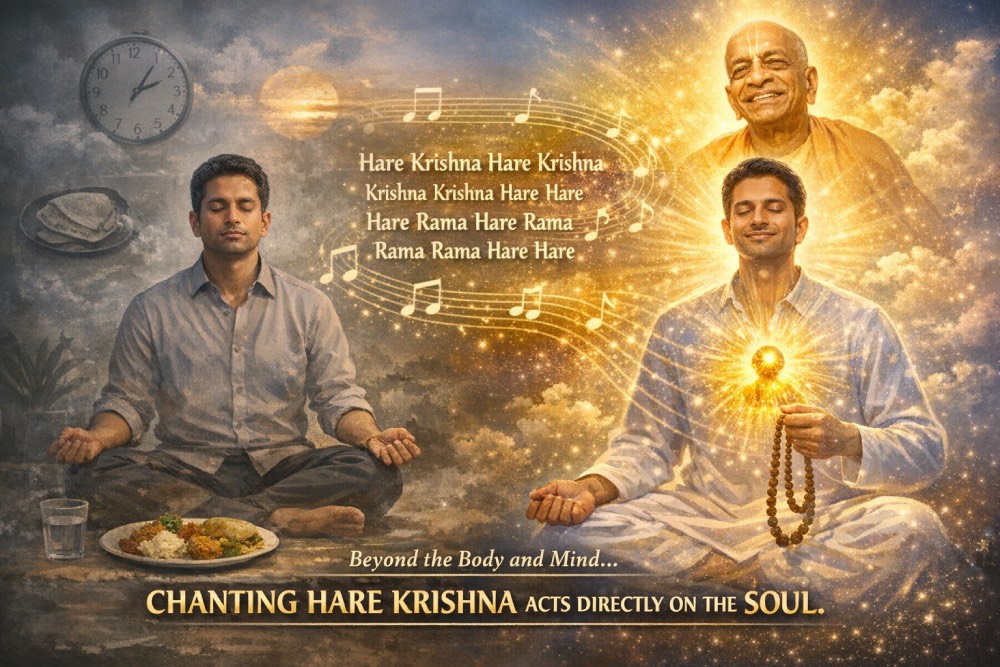
However, mantra meditation—especially the chanting of the Hare Krishna maha-mantra—operates on a completely different level. As Srila Prabhupada repeatedly explains, the holy name is transcendental. It does not belong to the body or mind but acts directly on the soul. Therefore, chanting Hare Krishna is not restricted by bodily conditions like eating or not eating. It is effective at all times and in all situations, because it works beyond the material platform altogether.
Why Food Matters in Material Meditation
In many meditation systems, the practice is centered on the body and mind. Techniques such as breath control, concentration on silence, or mental visualization depend heavily on physical balance and mental alertness. Because of this dependence, bodily conditions directly influence the quality of meditation.
When a person eats heavy food, the body’s energy is diverted toward digestion. This often affects:
- Breathing, which may become slower or irregular
- Alertness, leading to dullness or sleepiness
- Posture and focus, making it harder to sit steadily and concentrate
For these reasons, material meditation systems usually recommend practicing on an empty or light stomach. These guidelines are practical within their framework, because the success of such meditation depends on maintaining bodily and mental equilibrium.
However, it is important to understand that these rules apply only to body–mind meditation. They do not apply to transcendental practice, such as chanting the Hare Krishna mantra, which functions independently of the body and mind and acts on a higher, spiritual platform.
What Is True Transcendental Meditation?
True transcendental meditation means rising beyond the body and the mind. It is not simply calming the nerves, controlling the breath, or suspending thoughts. Rather, it is a spiritual activity performed on the level of the soul, which is distinct from both gross and subtle matter.
Srila Prabhupada explains that mantra meditation—especially the chanting of the Hare Krishna maha-mantra—is inherently transcendental. The holy name is not a product of the material mind; it is spiritual sound descending from the spiritual platform. Because of this, chanting does not depend on physical conditions such as posture, breath, time, or whether one has eaten or not.
Since the mantra acts directly on the soul, it remains fully effective in all circumstances—before eating, after eating, while walking, or even when the mind is disturbed. This is the unique mercy of the holy name: it does not require us to first become physically or mentally perfect. Instead, by chanting, the soul is gradually purified, and transcendental consciousness naturally awakens.
Hare Krishna Chanting Is Already Transcendental
Hare Krishna chanting is not a practice of silence, breath control, or mental imagination. It is not dependent on suppressing thoughts or manipulating the life air. Srila Prabhupada clearly explains that the holy name is spiritual sound vibration, originating from the transcendental platform and descending into this material world for the benefit of all living beings.
Because the Hare Krishna mantra is spiritual, it directly connects the chanter with the Supreme Lord through sound. This connection does not require any preliminary qualification. One does not have to purify the body or mind first; the chanting itself performs the purification.
For this reason, Hare Krishna chanting can be practiced:
- After eating
- While walking
- At home, at work, or in any condition of life
Srila Prabhupada often emphasized that devotional service is not governed by material limitations. This principle is also explained in the Bhagavad Gita, where Krishna states that one who engages in unalloyed devotional service transcends the three modes of material nature. Since chanting Hare Krishna is pure bhakti, it naturally functions beyond sattva, rajas, and tamas. Therefore, bodily conditions—such as whether one has eaten or not—do not restrict the transcendental potency of the holy name.
Beyond the Three Modes of Nature
In material life, everything—including food—acts under the influence of the three modes of material nature: sattva (goodness), rajas (passion), and tamas (ignorance). What we eat affects the body and mind, shaping our clarity, restlessness, or dullness. Thus, after eating, the body naturally comes under the influence of one of these modes.
However, Hare Krishna chanting does not belong to the material platform. Srila Prabhupada explains that the holy name is completely spiritual and therefore transcends the three modes of nature. It is not produced by sattva, rajas, or tamas, nor is it weakened by them.
Rather than being limited by the modes, the holy name purifies them. Even when the body is influenced by heaviness or dullness after eating, chanting continues to act spiritually, gradually elevating the consciousness beyond material conditioning. This is the unique position of bhakti: instead of waiting for the body and mind to become pure, chanting itself brings purification and lifts one above the modes.
Why Chanting Before Eating Still Helps
Although Hare Krishna chanting is fully transcendental and effective at any time, Srila Prabhupada also encouraged attentive chanting. For this reason, many devotees prefer to chant before eating—not as a rigid rule, but as a practical preference.
Before eating, the mind is generally lighter and more alert. There is less bodily heaviness, and fewer distractions arising from digestion. As a result, it becomes easier to hear the holy name clearly and remain attentive throughout the chanting process.
It is important to understand the distinction here. Chanting before eating does not make the chanting more valid, nor does chanting after eating make it less spiritual. The difference lies only in quality of attention, not in the transcendental potency of the holy name. Srila Prabhupada’s emphasis was never on external perfection, but on gradually developing sincere and attentive chanting through steady practice.
The Key Principle
The most important instruction given by Srila Prabhupada is simple and reassuring: chanting at any time is always better than not chanting at all. The holy name is not a mechanical process that works only under ideal external conditions. It is living, conscious, and deeply merciful.
Srila Prabhupada often emphasized that there are no hard and fast rules for chanting the Hare Krishna mantra. Whether one chants before eating or after eating, in a peaceful state or a disturbed one, the holy name continues to act spiritually. Its power does not depend on our perfection; rather, it gradually brings us toward purification and steadiness.
Therefore, consistency is far more important than ideal timing. Waiting for the “right” bodily or mental condition can become an obstacle, whereas regular chanting—even in imperfect circumstances—keeps one connected to the transcendental platform. The holy name rewards sincerity, not external arrangement
Conclusion
Physical restrictions such as posture, breathing, and eating apply to material meditation systems that function on the level of the body and mind. In such practices, external conditions play a decisive role in determining one’s experience.
Hare Krishna chanting, however, is true transcendental meditation. As taught by Srila Prabhupada, it is a spiritual activity performed on the platform of the soul. Because it transcends the body and mind, it is not restricted by whether one has eaten or not. The holy name remains fully potent before eating, after eating, and in all conditions of life.
Rather than waiting for ideal circumstances, one should take shelter of the holy name at every opportunity. This is the unique mercy of bhakti: it does not depend on material purity, but it creates purity.
The holy name is not bound by the stomach—it purifies it.